
Why I Paused My Property Purchases in 2022: A Case Study
By Scott A. Stanfield

Operating any business requires a solid strategy, which is developed by understanding the various elements that affect that business. In real estate business, understanding and leveraging the real estate market cycle is crucial for creating a successful investment strategy. This series has explored several factors influencing the market cycle, including interest rates, appreciation, and crowd psychology. We have also discussed various analytical tools that can help achieve a deeper understanding of these factors. One of the main tools available is analyze historical data to observe how the market has been affected over time.
The remaining three articles in this series will aim to accomplish two things:
1. Demonstrate how to incorporate market-generated data and theory into a business plan by sharing my plan and examining a case study.
2. Answer one of the most common questions I receive as a guest on various podcasts: “Why did you stop buying properties in 2022, and when will you start again?”
The business plan I have created for myself incorporates data-driven criteria and historical perspectives discussed throughout this series. By integrating these insights into my plan, I have been able to remove emotions from my investment decisions and adjust my portfolio accordingly.
Understanding the Market: My criteria
I developed a series of checklists and questionnaires based on historical data, my purchasing criteria, and lessons I have learned. Each month, I evaluate my portfolio using my Monthly Business Management Checklist. This checklist includes specific economic criteria that guide my decisions on whether to buy new properties and has been instrumental in helping me navigate the complex and often volatile real estate market.
Here’s a detailed look at the criteria I use:
Years Since Last Recession
As we discussed in the article The Four Phases of the Real Estate Market Cycle: Recovery, Expansion, Hyper Supply, and Recession, historical data shows that the real estate market cycle averages around 18.6 years between recessions, with cycles ranging from as short as 15 years to as long as 21 years. Despite varying economic conditions, this data demonstrates market cycle’s consistency. This consistency led me to use the time elapsed since the last recession as one of the criteria to anticipate market shifts. The last real estate recession began in 2007, and by 2022, nearly 15 years had passed, suggesting we were due for a slowdown.
Likely Phase of the Real Estate Market:
The foundation of a robust real estate investment strategy lies in recognizing which phase of the market cycle we are currently in – recovery, expansion, hyper supply, or recession. Each phase presents unique opportunities and risks.
I estimate the market phase by analyzing various economic indicators, such as GDP, interest rates, supply and demand, along with historical data and market trends. I have established criteria for each phase based on how the real estate market has performed during these phases in the past, as well as my own risk tolerance. Identifying the current market phase can help guide your decisions on when to buy, sell, or hold.
- Recession Phase:
Buy properties only after the market has bottomed out. Focus on cash flow properties with two-year leases to ensure stability during recovery. Have a large reserve fund. - Recovery Phase:
Buy both cash flow and appreciation properties, with two-year leases. This phase is ideal for acquiring properties that will benefit from the market’s rebound. - Early to Middle Expansion Phase:
Continue purchasing properties, with a focus on both appreciation and cash flow. This is typically a growth phase, so strategic buying can lead to substantial gains. - Last Quarter of Expansion:
Consider holding off on purchases. If buying, focus only on high cash flow properties with solid rent returns (a return of at least 20-30% of the gross rent). Prepare for the hyper-supply phase by focusing on financing options that increase cash flow, reduce debt, and/or increase reserves. - Hyper-Supply Phase:
Pause buying new properties. Instead, concentrate on increasing cash flow, reducing debt, and building reserves to weather the potential downturn.
- Recession Phase:
In January 2022, I estimated the market was in the final quarter of the expansion phase. Armed with this information, I made several strategic decisions to position my portfolio for what I believed was an impending downturn.
Taking Action in January 2022
Since the market data indicated that we were in the final quarter of the expansion phase, I focused on preparing my portfolio for the upcoming hyper supply and recession phases. To do this, I needed to increase cash flow, reduce debt, and/or build up my cash reserves. Several factors influenced my decision, including appreciation and interest rates. I ran my portfolio through multiple scenarios to understand how different options might affect it. After evaluating these scenarios, I determined the following was best suited to my portfolio and comfort levels.
1. Refinancing to Improve the Financial State:
In January 2022, with historically low interest rate of 3.2%, I had four properties in my portfolio with interest rates of 5.5%. I decided to do a cash-out refinance on these properties, which lowered my interest rate to 3.25% on a 30-year fixed mortgage. This move freed up over $100,000 in equity without affecting my monthly cash flow. Maintaining monthly cash flow during a recession is crucial, making this a critical step. It significantly increased the loan paydown on my portfolio by reducing the mortgage interest expense while keeping the monthly cash flow unchanged.
2. Purchasing New Properties:
I used the cash from the refinance to purchase two properties in Alabama, both financed at a 3.25% interest rate with 30-year fixed mortgages. These properties were projected to generate approximately $340 per month in cash flow and were secured with two-year leases, including a $50 monthly rent increase in the second year. These purchases increased my monthly cash flow by $680 in the first year. The additional revenue is beneficial for growing reserve funds and covering unforeseen expenses during a potential recession.
The Importance of Timing
Appreciation is one of the key factors I consider when deciding to stop purchasing new properties. Typically, appreciation peaks in the last quarter of the expansion phase and continues into the hyper-supply phase. Stopping early can be beneficial because this final push from the market is crucial for lowering your loan-to-value ratio, which, in turn, provides greater financial flexibility.
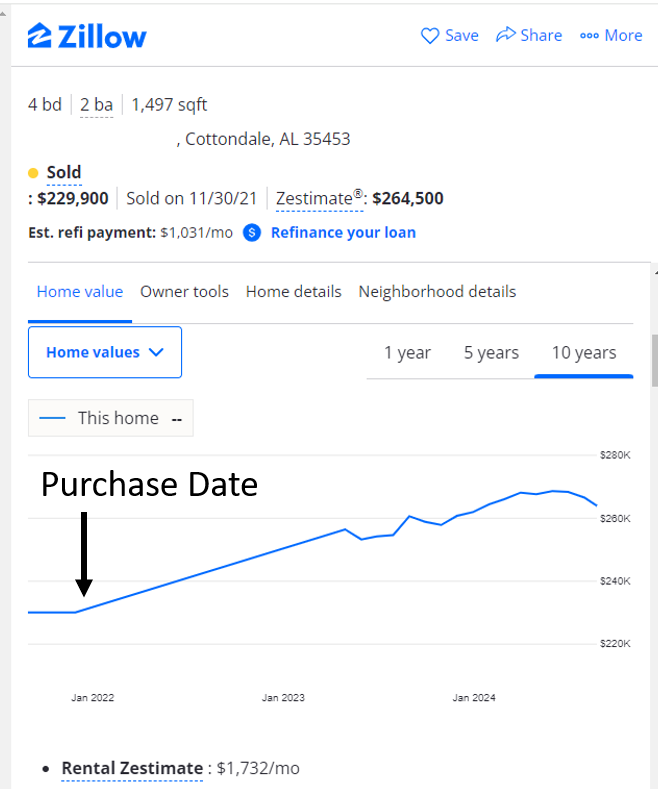
While the Zestimate isn’t as accurate as a professional appraisal, it provides enough insight to reflect the value added through appreciation at the end of the expansion phase. The Zestimate for the two properties I purchased in Alabama in January 2022, as shown above, indicates they appreciated by $35,000, representing nearly a 15% appreciation rate.
This final market push, combined with my decision to execute a cash-out refinance and purchase two new properties, affected my portfolio in the following ways:
Portfolio Growth
- Portfolio value increased from $2,511,200 to over $3,000,000.
- Total debt decreased from $1,666,074 to $1,570,000 due to loan paydown.
- The loan-to-value ratio dropped from 66.3% to 52.3%.
I did not have to make additional mortgage payments to decrease my loan-to-value ratio; market forces, through appreciation, accomplished this for me. This is one of the key advantages of stopping property purchases during the last quarter of the expansion phase. The significant reduction in leverage means the market would have to drop substantially before my portfolio would be underwater. By halting new property purchases after January 2022, I allowed myself ample time to build reserve funds, which will help me ride out a potential recession.
In October 2022, the Federal Reserve began raising interest rates, further validating my theory that we were at the end of the expansion phase and entering the hyper-supply phase. This development only strengthened my conviction in the strategy I had adopted.
Conclusion
My decision to pause property purchases in January 2022 was guided by established criteria developed through insights into historical market cycles. If I am wrong and the market continues to expand, my portfolio remains well-positioned for growth. However, if I am right, I’ll have the resources needed to weather a recession.
I hope this case study provides a clear explanation of why I stopped buying properties. As for when I will start purchasing again—stay tuned. My criteria will once again be the guiding force, and I will share the exact moment and reasoning in an upcoming article.
This case study shows the importance of developing a real estate investment strategy that incorporates market cycle insights, enabling you to position yourself for success amid the dynamics of a changing market. By applying these principles, investors can make informed decisions, minimize risks, and capitalize on opportunities, ultimately achieving their investment goals.
Thanks for reading,
-Scott
If you found this article insightful, make sure to subscribe to my blog for more in-depth analyses and updates on my real estate journey. Don’t miss out on the next article where I’ll discuss when I plan to re-enter the market and the criteria that will guide that decision.
The Monthly Business Management Checklist as well as all other checklists and questionnaires can be found in my book: Passive Profits: The Turnkey Rental Investor’s Guide