
When Will I Start Buying Properties Again?
By Scott A. Stanfield

In my previous article, I explained why I decided to pause purchasing rental properties in 2022, driven by specific economic criteria and market dynamics that signaled a potential downturn. As the real estate market continues to evolve, many of you have asked, “When will you start buying again?” This article will explore the factors I’m monitoring and the specific criteria that will guide my decision to re-enter the market. Whether you are a seasoned investor or just starting out, understanding these key indicators can help you make informed decisions about your own investment strategy.
My Approach to the Real Estate Market Cycle
I use several key concepts from real estate market cycle theory. Firstly, the U.S. real estate timeseries has been recorded since the early 1800s, documenting many recessions. The average time between recessions is 18.6 years, with the shortest and longest periods being 15 and 21 years, respectively. I use these timeframes as a gauge to assess when the probability of a recession is more likely.
Not all recessions result in a market crash like the one experienced from 2007 to 2009; most are simply slowdowns marked by a retracement in property values and increased vacancies. To protect my capital and portfolio, I prepare for the worst-case scenario—a market crash—when approaching the end of a cycle. However, your risk tolerance may differ, so consider what is best for you.
The real estate market cycle theory also outlines four distinct phases: recovery, expansion, hyper-supply, and recession. While the model isn’t perfect, it helps me sift through vast amounts of economic data and categorize the current state of the market. This simplicity is invaluable for developing a cohesive theory and, ultimately, a plan.
To identify the current phase, I use market-generated data such as home prices, new build permits, rental rates, vacancy rates, GDP, real estate index funds, and housing supply. I also consider additional variables that may be relevant to the specific market I am evaluating.
Key Indicators I’m Watching
- Years Since Last Recession: The last real estate recession began in 2007—17 years ago. Given the historical average, we are due for a recession soon.
- Current Market Phase: I believe we are currently in a recession phase. The key uncertainty is whether this is a brief retracement followed by a rapid, short-lived expansion and then a more serious recession, or if we are already near the bottom.
- Other Economic Indicators: I monitor home prices, new build permits, rental rates, vacancy rates, GDP, real estate index funds, and housing supply to gauge the market phase.
My Strategy for Each Market Phase
Based on historical performance, here’s how I apply my criteria depending on the market phase:
- Recession Phase: Buy properties only after the market bottoms out. Focus on cash flow properties with two-year leases to ensure stability during recovery and maintain a large reserve fund.
- Recovery Phase: Buy both cash flow and appreciation properties with two-year leases. This phase is ideal for acquiring properties that will benefit from the market’s rebound.
- Early to Middle Expansion Phase: Continue purchasing, with a focus on both appreciation and cash flow. This is typically a growth phase where strategic buying can lead to substantial gains.
- Last Quarter of Expansion: Consider holding off on purchases. If buying, focus only on high cash flow properties with solid rent returns (ideally $300 per month or a return of at least 20-30% of the gross rent). Prepare for the hyper-supply phase by focusing on financing options that increase cash flow, reduce debt, and/or increase reserves.
- Hyper-Supply Phase: Pause buying new properties. Instead, concentrate on increasing cash flow, reducing debt, and building reserves to weather the potential downturn.
When will I buy again? When I believe we are firmly within the recovery or early expansion phases.
Exceptions to Every Rule:
While my criteria suggest not purchasing during the hyper-supply phase, there are exceptions. For example, when the Federal Reserve began raising interest rates, I analyzed historical data to understand the potential impact on my rental portfolio.
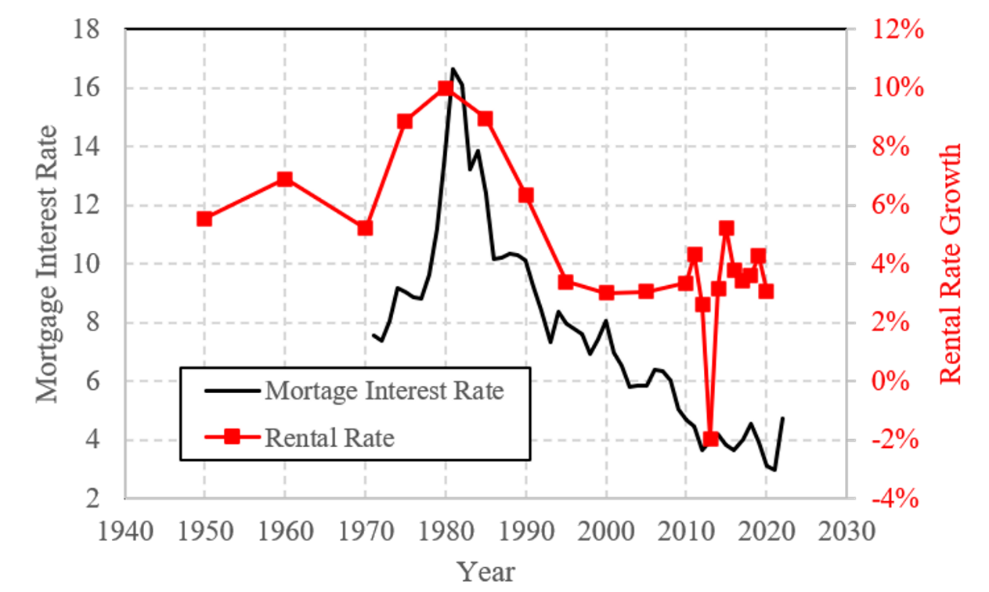
Figure 2. Comparison between mortgage interest rate and rental rate growth. (https://fred.stlouisfed.org/)
As the chart above shows, mortgage rates and rental rates often rise together, suggesting that early purchases during a rate hike could be advantageous under specific conditions. However, this strategy depends on individual resources and goals. I considered this plan but decided against it due to my risk exposure at the time.
Takeaway: Stick to your plan, but remain flexible. The market is dynamic, and opportunities can arise unexpectedly. Look for deals that align with your criteria, but avoid forcing a purchase
Market-Specific Risks and How They Affect My Strategy
The market is currently filled with risks that could significantly impact investment decisions. Here are some of the key risk sources I’m monitoring:
- Retail Real Estate
During the pandemic, many predicted a crash in the retail sector, especially with the rise of e-commerce. While the vacancy rate rose above 7% in 2022, the sector adapted by finding a balance with online commerce, and the vacancy rate has since dropped to just above 5%. While this was initially a concern, retail now appears more stable. You can read more about it here.
- Multifamily Real Estate
A recent report by Fannie Mae about the state of multifamily can be found here. To summarize, the multifamily rental sector is experiencing turbulence, which varies by metro area due to differing supply levels across the country. Typically, when market forces control the market, many new builds enter the market during a hyper-supply phase, which is currently evident in the multifamily sector. In contrast, there has been government intervention in the single-family housing market, preventing the influx of new builds typically associated with a hyper-expansion phase. According to the report, Fannie Mae expects concessions to increase, indicating a challenging leasing environment for multifamily housing—another characteristic of the hyper-supply phase. Based on this report, I estimate that the multifamily sector is in the hyper-supply phase and could be heading toward a recession. Fannie Mae also identifies single-family housing as a significant risk factor for the multifamily sector. The demand for multifamily units is largely driven by the low inventory of single-family homes. If a supply of affordable single-family homes becomes available, the demand for multifamily units could drop significantly, potentially pushing the multifamily sector into a recession. The report also concludes that more normal trends in rental rate growth and vacancy rates are unlikely to return until 2025 or later. For this reason, if I were buying now, I would focus on single-family homes instead of multifamily. This is particularly relevant given the likelihood that the Federal Reserve may begin quantitative easing—a monetary policy tool used by central banks to increase the money supply and lower interest rates—which could significantly impact the landscape of single-family housing.
- Office Space
Office space is currently one of the most significant risk factors. The vacancy rate reached 20.1% in Q2 2024, a record high, and is expected to continue rising through 2026. This indicates a sector in recession, which does not suggest a strong overall market recovery.
- Consumer Affordability
The affordability crisis is another critical factor. The figure below shows the ratio of the average home price to the average annual salary.
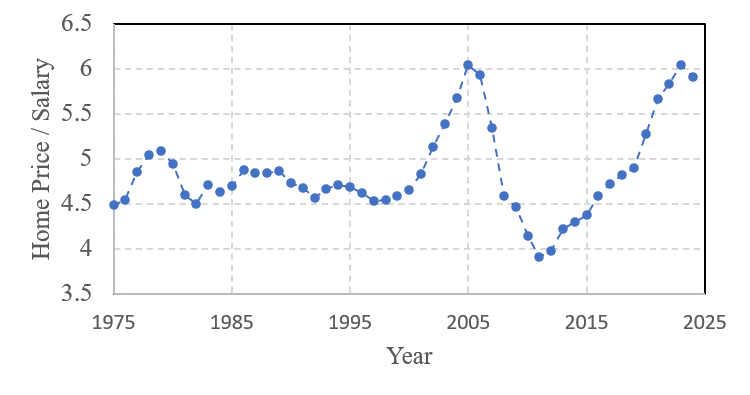
As shown, the ratio of home prices to annual salaries has escalated dramatically, indicating a growing disconnect between wages and housing costs, which could suppress future demand. I am looking for signs that this affordability gap is starting to close, whether through wage growth, price adjustments, or policy changes. A healthy market should not exhibit such disparities.
My Criteria for Starting to Buy Again
Given the current environment, filled with uncertainties and risks, I don’t see clear signs of recovery or early expansion. Until I do, I will remain cautious. Here’s what I’m specifically looking for:
- Clear signs of recovery: Evidence that the market has bottomed out and is transitioning to a recovery phase.
- Stabilized or lower interest rates: Conditions that make borrowing more affordable, enhancing ROI potential. Any changes in interest rates take a long time to be fully absorbed by the market.
- Improved supply-demand balance: A healthy market with adequate demand for new and existing homes.
- Positive trends in commercial real estate: Reduced risks in office and multifamily sectors, contributing to overall market stability.
- Improved affordability metrics: Indicators that housing costs are becoming more aligned with consumer income levels.
Conclusion: Patience and Preparedness
For now, my strategy is to remain patient and prepared. I have positioned my portfolio conservatively, focusing on strong cash flow and building reserves, ready to capitalize on the next expansion phase when it arrives. By closely monitoring these key indicators, I aim to make data-driven decisions that align with my long-term investment goals.
If you are in a similar position or considering when to enter the market, I encourage you to develop your own criteria based on the factors that align with your risk tolerance and financial objectives. The goal is to be ready when the right opportunity presents itself.
The final article in this series will discuss the specific actions I plan to take when re-entering the market and how you can do the same, whether you have an existing portfolio or are just getting started in real estate investing.
Thanks for reading,
-Scott