
Personal Financials, Objectives, and Goals
By Scott A. Stanfield PhD
The first article in this series, Introduction to Cash Flow and Appreciation Properties, covered some of the basic differences between cash flow and appreciation properties. One of the initial steps mentioned was to establish your financial state. This is an important piece, because your financials play a crucial role in how you can build and modify your business plan. In this article, we will go more in-depth on establishing your baseline financial state and show how it can be modified by the business choices that you make.
The Financial State
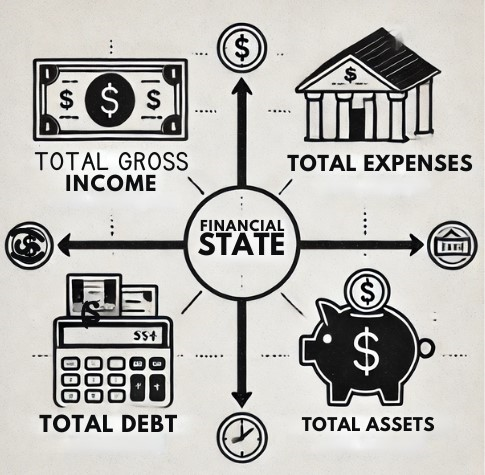
Your financial state can be sorted into four main categories. Each one of these categories can then be subcategorized to help with tracking and monitoring your financial state.
What are Cash Flow and Appreciation Properties?
Total gross income is the total of all of your revenue streams and is what you make prior to paying expenses. Once you have categorized and determined your expenses you can calculate your net income. Your net income is the amount leftover after all your expenses are taken care of.
Net Income=Total Gross Income-Total Expenses
Total Expenses
Total expenses can be further divided into fixed and discretionary expenses.
- Fixed expenses are considered necessary expenses and include items such as income tax, housing, transportation, food, utilities, and medical costs.
- Discretionary expenses include items such as entertainment and other non-essential purchases that can be reduced to potentially save funds for other ventures.
Total Debt
Total debt includes all money owed to banks, credit card companies, student loans, etc. It can include both good and bad debt.
- Good debt is a debt that is tied to an appreciating, or income producing debt, such as a house.
- Bad debt is tied to a depreciating asset (looses value) over time such as a vehicle.
When it comes to tracking debt there are a few categories that I prefer to use.
- Personal residence
- Rental properties
- All my other debt
There are some benefits to tracking debts separately. One of the main benefits is in the application of lending products. Products for personal residences usually have more favorable terms than those for rental properties. It’s good to track rental property debt separately so that equity can be leveraged appropriately when it is time.
Total Assets
Total Assets are the monetary value of all of your belongings and can include cash, properties, stock, retirement accounts, cars, jewelry, and collectables. Assets can further be divided into appreciating (items expected to increase in value over time) and depreciating (items expected to decrease in value over time). There are five categories that I like to use to track assets:
- Cash: Liquid assets representing reserve and investment funds.
- Value of my rental portfolio: Monitored monthly to evaluate portfolio performance and to determine when changes are needed.
- Value of my personal residence: It is always a good idea to keep your personal residence separate from your investment business.
- Value of my retirement account: I monitor my retirement account separately because I can borrow against it at a low-interest rate for investment purposes. Seek professional guidance prior to doing this.
- Value of everything else
Setting Objectives and Goals
Any objective or goal that you have set can be achieved by modifying one of the four financial categories. Once you have your baseline financials laid out in front of you, you can then begin to see what modifications would work best to achieve your goals.
One of my first goals was to increase my cash flow so that I could invest money into more rental properties. To achieve this goal, I crafted the following plan:
- Reduce my expenses so that I could save money for investing.
- Increase my good debt to maximize leverage in order to increase my assets and, therefore, my cash flow from these assets.
- Minimize my risk by balancing the total expenses of my first rental property with my net W-2 income. By doing this, I was able to cover all of the expenses of a rental property even when it was not tenanted. This turned out to be excessive, but it gave me peace of mind.
By crafting a plan that fit my needs, I was able to begin my investing career. One thing to keep in mind is that the plan you create needs to remain fluid. By that, I mean you should always evaluate your current portfolio, your current financial state, and adjust your plan accordingly. The real estate market is a dynamic force that is constantly changing, and you need to be able to change direction with it.
Conclusion
Any business venture starts with a plan. These plans are derived from your personal goals, risk tolerance, and financial abilities. Knowing, evaluating, and changing your financial state can help keep you out of tight spots and prevent you from missing potential golden opportunities. Cash flow and appreciation properties can be used as tools to help direct the financial state of your portfolio in the direction that you want to go. Stay tuned for the next article where we will dive deeper into cash flow properties.
Thanks for reading,
-Scott