
Managing Variable Expenses in Turnkey Rental Properties: A Strategic Guide for Savvy Investors
By Scott A. Stanfield

Introduction: Understanding the Cost Landscape
Investing in turnkey rental properties offers a pathway to financial independence for savvy investors. Yet, the unpredictability of variable expenses can erode potential profits. This guide, enriched with a detailed case study, sheds light on mastering variable expenses for enhanced profitability in real estate investments.
Fixed vs. Variable Expenses: Mastering the Basics
Before diving into the complexities of variable expenses, it’s essential to differentiate them from their fixed counterparts. Fixed expenses, such as mortgage payments, property taxes, and insurance premiums, are predictable and consistent. In contrast, variable expenses—comprising maintenance, repairs, and tenant turnover—demand a more nuanced approach due to their fluctuating nature.
Exploring Variable Expenses: A Detailed Analysis
Variable expenses are multifaceted and significantly impact the financial health of rental properties. Understanding these costs is crucial for effective budget management; for simplicity, I will classify them in three buckets:
- Capital Expenditures: Large-ticket items, including the roof, HVAC system, and hot water tank, constitute significant capital expenditures. Choosing properties with brick exteriors can notably decrease these expenses by removing the necessity for siding replacements. The average expected service life of these items—over 100 years for brick, 25 to 50 years for roofs, 15 to 25 years for HVAC systems, and 10 to 15 years for hot water tanks—is essential in financial planning and investment decision-making.
- Repairs and Maintenance Expenses: These operating expenses include repairs and maintenance expenses that are incurred while a tenant occupies the property. I like to separate expenses that occur during occupancy from those that occur during turnover, as I find it helpful when building a budget.
- Tenant Turnover Costs: Also considered operating expenses, they are often the most significant source of variable expenses, tenant turnover encompasses several costs, including leasing fees, vacancy losses, utilities during vacant periods, and both interior and exterior cleaning and maintenance. Specific activities might involve repairing damaged drywall, repainting, recaulking windows, toilets, and sinks, rekeying locks, and replacing batteries in smoke detectors. The leasing fee typically equals one month’s rent, and vacancies can extend up to four weeks, significantly impacting revenue. Note: Vacancy loss is not actually an expense but is a reduction in revenue. I like to include it as part of the turnover cost.
Case Study: Navigating Financial Planning with Real Data
Consider a 3-bedroom, 2-bathroom, 1,500 square foot ranch-style home, rented at $1,250 per month. This property exemplifies the strategic budgeting required for managing variable expenses effectively.
- Operating Expenses during tenancy: Within my portfolio, the majority of repair and maintenance expenses arise during tenant turnover and not during occupancy. In 2023, the average expense incurred for occupied properties was approximately $220 per property. You may choose to increase this value, but please note that the current value modifies the answer by less than 5%.
- Tenant Turnover Overview: According to my property management teams, the average tenancy duration is 5.5 years, although other sources suggest 3 to 3.5 years. My portfolio of turnkey rentals, which is 7 years old, averages just under 6 years per tenancy. For budgeting purposes, I have used a 5-year average. Tenant turnover costs include a leasing fee of $1,250 (1 month rent), a decrease in revenue from a vacancy loss of $1,250 (1 month vacancy), and an estimated $1,000 for maintenance and repairs, totaling $2,500 in expenses and $1,250 in lost revenue. This loss is expected to increase, as the rental rate for this property is projected to rise by $25 per month each year based on historical data, affecting both the leasing fee and vacancy loss. I applied the historical average inflation rate to project maintenance and repair costs in future years. For example, by year 5, tenant turnover expenses are expected to increase from $3,500 to $3,840.36. It’s important to note that rent may decrease in some years. Nevertheless, this approach offers some guidance.
- Capital Expenses Overview: Initial estimates for replacing major components were $7,420 for the roof, $6,275 for the HVAC system, and $1,500 for the hot water tank. Projecting these costs over 30 years, with an average inflation rate of 3.3%, illustrates the significant financial impact of capital expenditures on investment returns. I considered two scenarios: replacing these systems at both the lower and upper ends of their estimated service lives. Using the historical inflation rate, I projected the future costs of these expenses. For instance, replacing the roof today costs an estimated $7,420, with the cost projected to increase to $16,708 in 25 years. The figure below displays the estimated total variable expenses accumulated over 30 years of service for this property.
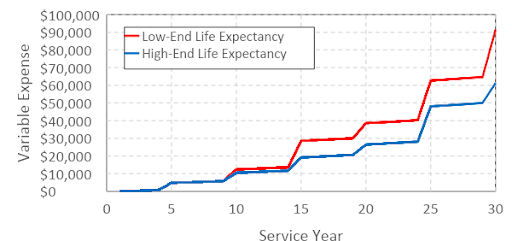
As shown, having to replace the big-ticket items at the low-end service life instead of the high-end service life increases the accumulated expenses by over $30,000 after 30-years of service which represents a 50% increase. The figure below displays the percentage of the gross rent that is required to cover variable expenses. Note: This percentage represents the total gross rent collected from the first year of service through the 30th year of service.
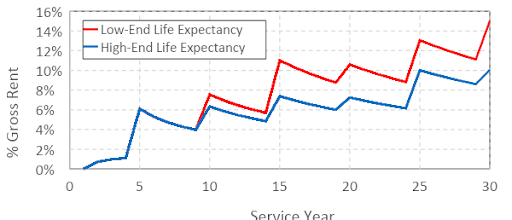
As illustrated, variable expenses increase over the property’s service life. An important question arises: What percentage of the gross rent leads to an acceptable profit margin? Our aim in addressing this question is to establish criteria for profit when evaluating properties to purchase. To achieve this, let’s calculate the funds remaining from the rent after covering variable expenses, assuming that fixed expenses have already been met. We will explore two scenarios: one where the funds remaining after monthly fixed expenses constitute 15% of the gross rent, and another where they make up 20% of the gross rent. These funds would then be available to cover the variable expenses. The property’s profit is essentially the funds left over after all variable expenses have been paid. Below, the profit by service year is displayed for scenarios with 15% and 20% of the gross rent remaining.
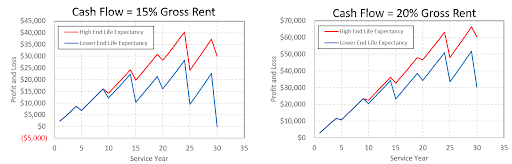
As demonstrated, allocating 15% of the gross rent to cover expenses results in a breakeven scenario by year 30 if capital expenses—such as the roof, hot water tank, and HVAC systems—need to be replaced at the lower end of their estimated service life. However, the likelihood of always having to replace these items at the lower end of their lifespan is very low. Therefore, in my business, I have established a criterion for cash flow to be 15% of the gross rent or higher after covering fixed expenses and my preference is be closer to 20%.
Strategies and Results: Enhancing Investment Returns
The analysis reveals that variable expenses, including tenant turnover, operating expenses during occupancy, and capital expenses, will consume approximately 15.4% of total gross rent over 30 years. This insight is invaluable for setting realistic and profitable investment criteria.
Investment Strategies for Success
The results can be used to devise strategies and establish investment criteria. Below are a list of strategies and criteria I include in my business plan.
- Strategic Purchasing Criteria: Conducting a detailed expense analysis enables investors to establish criteria ensuring a cash flow of at least 15% of the gross rent, with a target of 20%. This requirement is calculated after covering fixed expenses such as mortgage interest, property tax, property insurance, and property management fees. It’s important to note that the principal portion of the mortgage is not considered an expense. However, I account for it when evaluating cash flow. Why is this significant? Applying a quick rule, like needing the cash flow to exceed 15% of the gross rent, allows for the rapid evaluation of properties — within minutes instead of hours. This efficiency can be crucial in securing a profitable turnkey rental before it’s claimed by another investor.
- Choosing Durable Materials: Investing in properties with brick exteriors can significantly reduce long-term capital expenses.
- Preventive Measures for Capital Expenses: Ensuring that key components like roofs, HVAC systems, and hot water tanks are new or essentially new at the time of purchase minimizes unforeseen expenditures. This makes it where your expenses are more likely to follow those projected in the case study.
- Acquiring Tenanted Properties Without Leasing Fees: Opt only for properties that are already tenanted and negotiate to avoid leasing fees at closing. This is critical since turnkey providers may attempt to include a leasing fee at closing, even if the property is already tenanted. The argument here is that the leasing fee should be the responsibility of the property owner, and you were not the owner when the tenant was placed.
- Build an adaptable plan: Develop a plan that remains profitable indefinitely, even if you intend to sell the property before incurring major expenses in the later years. Remember, you may not be able to sell the property in later years due to unforeseen circumstances such as high interest rates or a strong buyer’s market.
- Criteria for Selling to Reduce Expenses: The analysis indicates an optimal period for selling through a 1031 exchange, which, based on this analysis, is shortly after 20 years of service. Additionally, at this point, you might benefit from the increased depreciation expense that results from completing the 1031 exchange.
Conclusion: Maximizing Your Real Estate Investment Potential
Mastering the management of variable expenses is crucial for the success of turnkey rental property investments. This guide, coupled with the detailed case study, offers a blueprint for investors aiming to maximize profitability through strategic financial planning and analysis.
Engage and Learn More
We invite you to dive deeper into the intricacies of real estate investment strategies. Share your experiences, challenges, and successes in the comments below, and explore our related guides for more insights into building a profitable real estate portfolio.
Thanks for reading,
-Scott